Beyond the Screen: A UX Research Thesis on XR Social Dynamics
Interactions in Extended Reality
Introduction
As Extended Reality (XR) redefines social interaction, how do we balance its potential for connection against the new risks to our privacy and identity?
This HCI Master’s thesis tackles this critical question by exploring the intricate dynamics of self-disclosure within emerging XR social settings. The research delves into user motivations, perceived benefits, and significant privacy concerns across various contexts, aiming to provide a deeper understanding of user behavior. Ultimately, this study offers key insights and actionable recommendations for designing future XR platforms that are engaging, respectful of user privacy, and foster a sense of safety and control.
The Core Challenge: Understanding Self-Disclosure in XR
- What motivates users to self-disclose information in XR social settings?
- What risks do users perceive when sharing personal information in these environments?
- How do varying social contexts and XR features influence users’ willingness to disclose, their comfort levels, and their privacy preferences?
Addressing these questions is crucial for developing XR platforms that are not only innovative but also ethically designed and aligned with user expectations for privacy and control.
Our Research Approach
To investigate the nuances of self-disclosure in XR social settings, this study adopted a mixed-methods research design. This approach allowed for a comprehensive understanding by combining quantitative data from surveys with rich qualitative insights gathered through in-depth interviews.
The research was conducted in the following key phases:
- Scenario-Based Surveys: An online survey was administered where participants evaluated their willingness to disclose various types of information across three distinct social XR scenarios: a casual pub, a professional conference, and a semi-professional university campus. These scenarios were chosen to represent diverse environments in terms of social context, size, and openness.
- In-depth Exploratory Interviews: Following the survey, semi-structured interviews were conducted with each of the 15 participants (aged 25-63 ) to delve deeper into their decision-making processes, motivations, perceived benefits, risks, and desired controls related to self-disclosure in XR.
- Thematic Data Analysis: Interview transcripts were systematically analyzed using a thematic analysis approach, supported by Atlas.ti software, to identify recurring patterns, user goals, and key themes concerning self-disclosure in XR environments.
Introduction to XR:
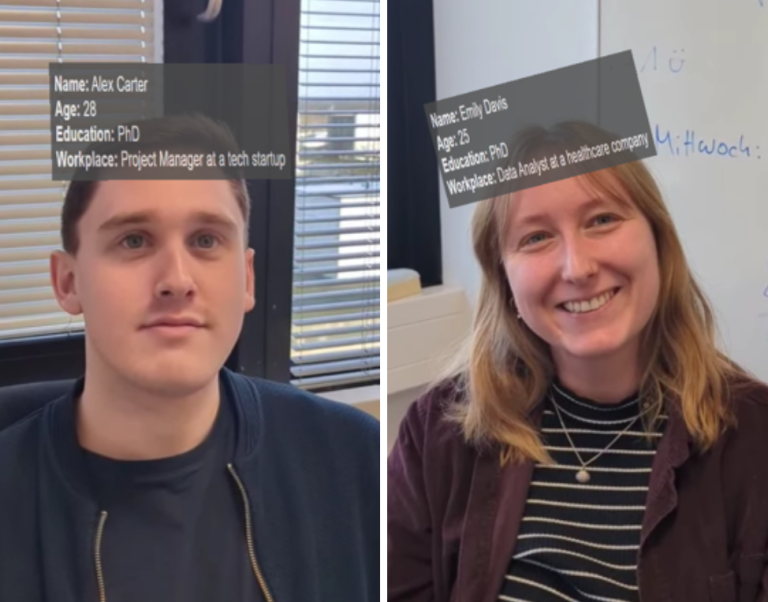
Prior to the survey, participants were familiarized with XR concepts and how information might be displayed in such environments, using a custom demo created with Meta Spark Studio. This ensured all participants had a foundational understanding of the technology being discussed.
In-depth Exploratory Interviews
To extract meaningful insights from the rich data gathered in the in-depth interviews, a rigorous thematic analysis was employed. This systematic process was essential for understanding the nuances of user perceptions and behaviors regarding self-disclosure in Extended Reality (XR).
The core stages of this analysis included:
- Data Preparation and Immersion: All interviews were meticulously transcribed. These transcriptions were then imported into Atlas.ti, a specialized software for qualitative data analysis, facilitating a structured approach. An iterative process of reading and re-reading the transcripts allowed for deep familiarization with the dataset.
- Hybrid Coding Strategy: A hybrid coding approach was utilized, strategically combining both top-down (deductive) and bottom-up (inductive) methods. The top-down approach leveraged existing theoretical frameworks and prior research on self-disclosure to guide initial coding. Simultaneously, the bottom-up approach enabled the identification of emergent themes and patterns directly from the participants’ narratives, ensuring that novel insights specific to the XR context were captured.
- Theme Development and Refinement: Through this dynamic and iterative coding process, core themes related to users’ self-disclosure goals, perceived benefits, and anticipated risks in XR environments were identified and developed.
Key Themes Uncovered in XR Self-Disclosure Research
Thematic analysis of the research data revealed distinct patterns in how users approach self-disclosure within Extended Reality (XR) social settings. These core themes illuminate the key motivations, perceived benefits, critical risks, and desired controls that shape user behavior as digital and physical interactions merge.
-
Context-Dependent Engagement
Users showed varied levels of willingness to join XR social networks, a decision heavily influenced by the specific social context (e.g., pub, conference, or campus).
-
Contextual Information Sharing
The type and amount of information users were willing to disclose were also found to be highly dependent on the social context of the XR environment.
-
Identity Clarification
Using disclosure as a means to accurately express oneself and to help guide others on how to interact appropriately in XR settings.
-
Relationship Development
Sharing personal information with the aim of forming or maintaining various types of relationships, whether professional, friendly, or romantic.
-
Social Control & Resource Gain
Strategically using self-disclosure to achieve specific personal or professional outcomes, such as business promotion or influencing social dynamics.
-
Sharing Contact Information
Disclosing details like name or email to facilitate future communication and networking beyond the immediate XR interaction.
-
Informed Interaction
Providing background information to enable more relevant, meaningful, and smoother conversations within the XR environment.
-
Targeted Communication
Strategically disclosing certain information to attract or engage with specific individuals or groups based on one's goals.
-
Shared Values and Interests
Revealing personal values and interests as a way to connect with and attract like-minded individuals in XR spaces.
-
Fear of Prejudgment
Concern about being prematurely judged or stereotyped by others based on the personal information disclosed in XR.
-
Inappropriate Disclosure
Discomfort arising from sharing or encountering information considered unsuitable or out of place for the specific social XR context.
-
Information Reaching Unintended Parties
Worry that disclosed personal data might be accessed by, or transferred to, unintended individuals, leading to privacy breaches.
-
Potential for Harassment
Fear of experiencing unwanted attention, stalking, or other forms of harassment as a result of information shared in XR.
-
Concerns Regarding Spam
Apprehension that personal contact details or other information might be exploited for unsolicited commercial messages and spam.
-
Enhanced User Control
A strong preference among users for granular control over their disclosed information – managing who sees what and when – believing it would increase their disclosure comfort.
-
Valuing Reciprocity
A significant interest in mutual disclosure, where seeing others' information is contingent on sharing one's own, perceived as fostering fairness, trust, and comfort.
Key Findings
This research uncovered several critical insights into how individuals approach self-disclosure in the nuanced context of Extended Reality (XR). The following section highlights some of the most significant findings, revealing distinct user behaviors, motivations, and concerns that are pivotal for understanding and designing future XR social interactions.
Context Dictates Willingness to Disclose
A key finding was that participants’ overall willingness to disclose personal information varied significantly depending on the social scenario. The highest willingness was observed in the Conference setting (66.2%), followed by the Campus (53.3%), and lastly, the Pub (50.8%). This underscores the critical role of context in XR disclosure decisions.
Unpacking the Perceived Benefits of XR Disclosure
Participants in the study identified several distinct advantages to sharing personal information within XR social settings. These perceived benefits, which varied in prominence across the different social scenarios, shed light on what users hope to gain from such interactions. The following table details the distribution of comments related to each type of benefit, illustrating how context shapes users’ expectations of positive outcomes from self-disclosure in XR.
| Benefit Type | Pub Scenario | Campus Scenario | Conference Scenario |
|---|---|---|---|
| Sharing Contact Info | 2 / 4.8% | 0 / 0.0% | 8 / 19.0% |
| Informed Interaction | 12 / 28.6% | 0 / 0.0% | 10 / 23.9% |
| Targeted Communication | 20 / 47.7% | 4 / 28.6% | 14 / 33.3% |
| Shared Values and Interests | 8 / 19.0% | 10 / 71.4% | 10 / 23.9% |
Navigating the Perceived Risks of XR Disclosure
Alongside potential benefits, participants expressed significant concerns regarding the risks associated with self-disclosure in Extended Reality (XR) environments. These perceived risks, much like the benefits, were shown to be highly context-dependent, varying in nature and prominence across the Pub, Campus, and Conference scenarios. Understanding these concerns is critical for designing XR systems that users can trust. The following table outlines the distribution of comments related to each type of perceived risk.
| Risk Type | Pub Scenario | Campus Scenario | Conference Scenario |
|---|---|---|---|
| Fear of Prejudgment | 5 / 17.2% | 5 / 33.3% | 4 / 17.4% |
| Inappropriate Disclosure | 1 / 3.4% | 4 / 26.7% | 12 / 52.2% |
| Information Getting to Unintended Places | 2 / 6.9% | 3 / 20.0% | 3 / 13.0% |
| Potential for Harassment | 11 / 37.9% | 3 / 20.0% | 1 / 4.3% |
| Concerns Regarding Spam | 8 / 27.6% | 0 / 0.0% | 1 / 4.3% |
| Reduced Emotional Connection | 2 / 6.9% | 0 / 0.0% | 2 / 8.7% |
Enhancing the Disclosure Decision Model for XR
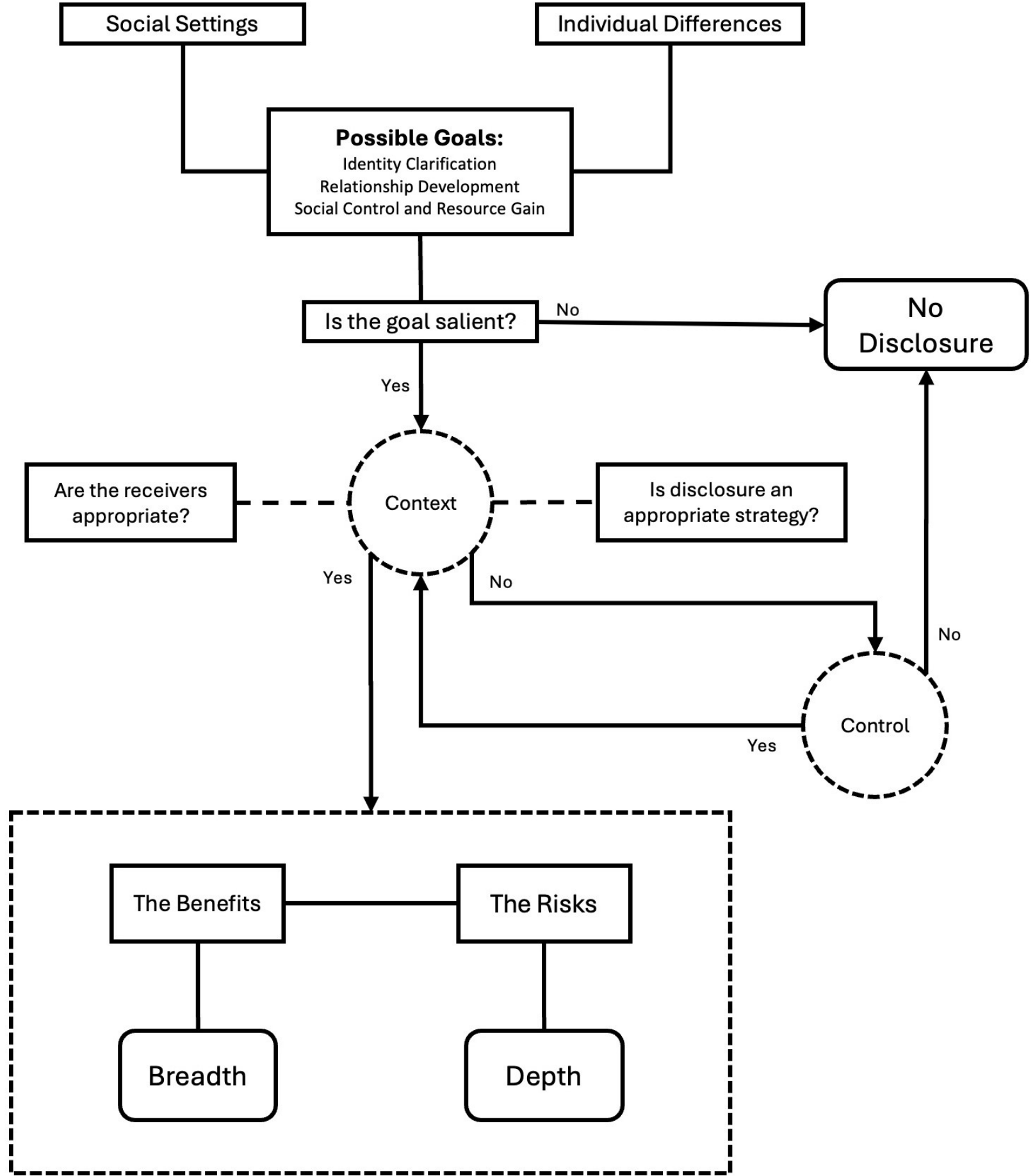
Building on established theories of self-disclosure, this research identified the need to adapt the traditional Disclosure Decision Model (DDM) for the unique characteristics of Extended Reality (XR). Our XR-Adapted DDM (shown below) emphasizes two critical factors amplified in these immersive environments: the dynamic social context, which significantly shapes perceived risks and benefits, and the user’s level of control over their information, which directly influences disclosure choices. This refined model offers a more nuanced understanding of how users navigate sharing personal information in hybrid realities.
Discussion & Implications
The findings from this research offer a nuanced understanding of self-disclosure in Extended Reality (XR), highlighting a complex interplay of user motivations, perceived benefits, risks, and the critical influence of social context. This understanding has significant implications for both theory and the practical design of XR social environments.
Theoretical Contributions
Our results largely align with foundational theories like Self-Presentation Theory and Social Exchange Theory, showing users strategically adapt disclosures to context and weigh perceived benefits against risks. However, the unique characteristics of XR—its immersive nature and the blending of physical and digital identities—necessitated a refinement of existing models. A key theoretical contribution of this work is an adapted Disclosure Decision Model (DDM) for XR social settings. This adapted model emphasizes the amplified role of context and user control in shaping disclosure decisions (depth and breadth) in these hybrid environments.
Practical Implications & Design Recommendations for XR Systems
Translating these findings into actionable insights, several recommendations emerge for creating more user-centric, engaging, and trustworthy XR social platforms:
- Develop Context-Aware Privacy Settings: XR systems should incorporate privacy controls that are sensitive to the user’s current social environment. For example, the system could suggest more conservative sharing defaults in professional settings compared to casual ones.
- Empower Users with Granular Control: Users expressed a strong desire for customizable privacy settings. Platforms should allow individuals to finely tune who can see specific pieces of their information and under what conditions.
- Implement Reciprocal Disclosure Mechanisms: To foster fairness and trust, XR platforms could integrate features that make information visibility conditional on mutual consent to share similar details.
- Introduce Tiered/Leveled Disclosure Options: Similar to existing social networks, allowing users to classify information into different tiers (e.g., “close connections,” “professional network,” “public”) could provide more intuitive control over disclosure.
- Provide Adaptive Prompts and Guidance: Systems could offer gentle prompts or alerts to users about potential risks or social norms relevant to disclosure in a given XR context, helping them make more informed decisions.